
Labor Day Lessons: Why Hard Work Alone Is Not Enough to Build a Successful Business
September 8, 2026The Woman Behind the Brand: What Building a Business Taught Me About Becoming Myself
September 11, 2026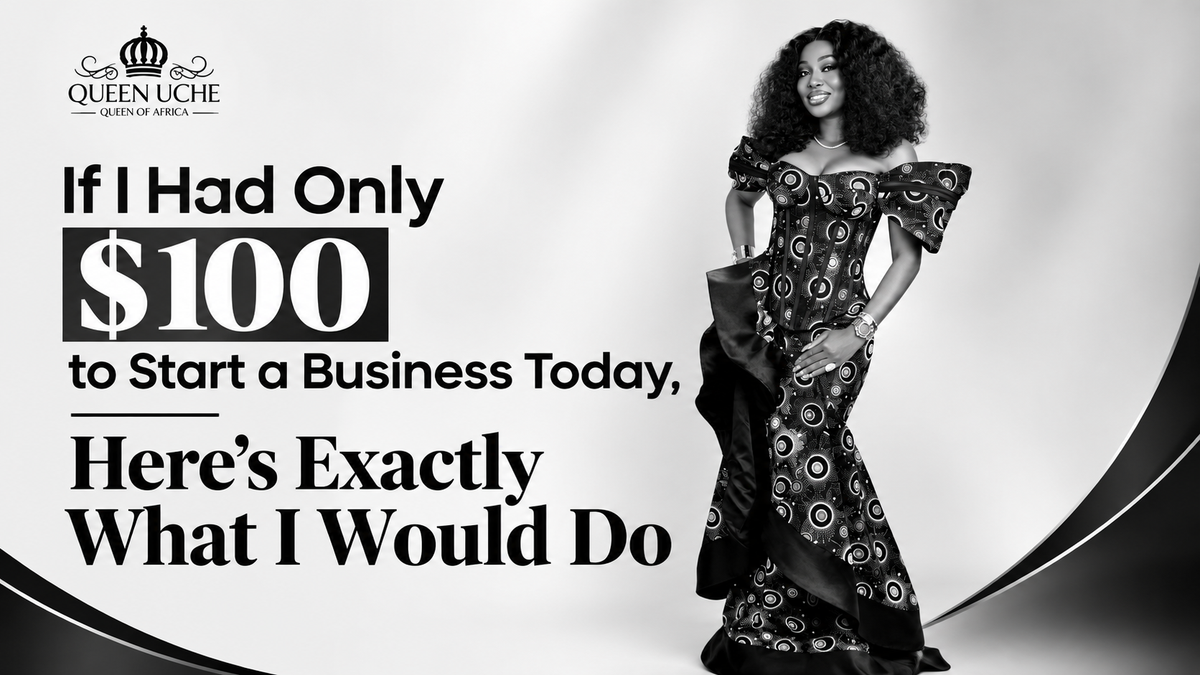
There is something liberating about starting with very little.
When you have $100, you cannot afford to waste money trying to look like a business owner. You cannot spend your entire budget on a logo, expensive packaging, an office, or a website nobody has visited.
You have to focus on what matters:
Find a problem. Solve it. Find someone willing to pay for the solution. Then do it again.
If I had only $100 to start a business today, that is exactly where I would begin.
And I say this as someone whose entrepreneurial journey started far from the polished image people see today.
When I started selling raw hair extensions in Los Angeles in 2010, I wasn’t walking into entrepreneurship with a huge corporate structure behind me. I started from my garage, with a trunk full of products and the determination to build something meaningful. That small beginning eventually became UCHE GROUP and UCHE HAIR, a global beauty business.
That experience taught me something I still believe today:
You don’t need a lot of money to start. You need to know what your money is supposed to accomplish.
So, if I woke up tomorrow with $100 and had to build a business from scratch, here’s my playbook.
First, I Wouldn’t Spend the $100 Yet
This may sound strange, but my first move would be not spending the money.
I would spend time identifying a problem.
What are people already asking for?
What do they complain about?
What do they struggle to find?
What are they currently paying someone else to solve?
That is where business opportunities live.
I wouldn’t start with:
“What business can I start with $100?”
I’d start with:
“What problem can I solve that someone is already willing to pay me for?”
That distinction can save a new entrepreneur from wasting months building something nobody wants.
Step 1: Start With a Skill, Not a Store
With $100, I would choose a business model that doesn’t require me to purchase large amounts of inventory.
That could be:
- Social media management
- Hair styling
- Personal shopping
- Beauty consulting
- Content creation
- Graphic design
- Photography
- Tutoring
- Virtual assistance
- Event services
- Consulting
- Digital products
- Reselling products after securing customers
The principle is simple:
Use what you already know before buying what you don’t need.
Your first business doesn’t have to be your forever business.
It simply needs to get you into the marketplace.
Step 2: I Would Talk to Potential Customers Before Building Anything
This is one of the biggest mistakes I see aspiring entrepreneurs make.
They create the product first.
Then the logo.
Then the Instagram page.
Then the packaging.
Then they wait for customers.
I would reverse that process.
I’d talk to at least 20 potential customers.
I’d ask:
- What is your biggest challenge with this?
- How are you currently solving it?
- What don’t you like about the solutions available?
- What would make you pay for a better solution?
- How much would you realistically spend?
I’m not looking for compliments.
I’m looking for buying signals.
Someone saying, “That’s a nice idea” doesn’t mean much.
Someone saying, “How much is it and when can I get it?” means everything.
Step 3: I Would Sell Before I Scale
This is where I would become extremely disciplined with my $100.
I would test the offer before investing heavily in it.
For example, imagine I wanted to sell a beauty product.
Instead of buying 50 units, I’d find out whether I could sell five.
If I wanted to offer social media management, I wouldn’t immediately build an agency.
I’d get my first client.
If I wanted to sell handmade products, I’d take pre-orders before producing a large batch.
Validation comes before expansion.
My first goal wouldn’t be 1,000 customers.
It would be:
Customer #1.
Then #2.
Then #5.
Then #10.
That is how momentum begins.
Step 4: I Would Use Social Media as My Free Storefront
I wouldn’t spend my first $100 building an elaborate website.
I’d use the platforms where my customers already spend their time.
Instagram.
TikTok.
Facebook.
WhatsApp.
LinkedIn, depending on the business.
I’d create content that answers three questions:
What do I sell?
Who is it for?
Why should someone trust me?
And I would tell my story.
People don’t only buy products.
They buy confidence.
They buy convenience.
They buy expertise.
They buy transformation.
That is something I’ve learned throughout my journey in beauty and entrepreneurship.
Queen Uche’s business philosophy has always connected business with empowerment and purpose, not simply transactions.
Step 5: Here’s How I Would Allocate the $100
If I absolutely had to spend the entire $100, I would make every dollar answer a specific business question.
| Investment | Budget | Purpose |
| Product/sample/first service delivery | $40 | Create something customers can actually experience |
| Customer acquisition/test marketing | $20 | Test whether the offer attracts buyers |
| Basic content/creative tools | $10 | Present the offer professionally |
| Transportation/data/communication | $15 | Reach and serve customers |
| Emergency/operating reserve | $15 | Protect against unexpected costs |
| Total | $100 |
Notice what is missing?
A fancy office.
Expensive branding.
Unnecessary equipment.
A huge inventory order.
At the beginning, my money would go toward learning what works and generating revenue.
Step 6: I Would Reinvest the First Profits
Let’s say that $100 helps me generate $250.
I wouldn’t immediately spend the $150 profit.
I’d ask:
What would make the next $250 easier to generate?
Maybe I need better equipment.
Maybe I need inventory.
Maybe I need better advertising.
Maybe I need a freelancer.
Maybe I need better packaging.
That’s when I would reinvest.
This is how a small business becomes a real business.
Not by constantly taking money out.
But by allowing the business to become stronger with every cycle.
This principle of reinvestment is consistent with Queen Uche’s broader approach to wealth: save intentionally, invest in growth, and scale sustainably rather than simply spending for appearances.
Step 7: I Would Track Every Dollar
One of the fastest ways to lose control of a small business is to mix business money with personal money.
Even if I’m starting with only $100, I would track:
Revenue
Expenses
Profit
Customer acquisition
Repeat purchases
Cash available
You don’t need complicated accounting software on day one.
A simple spreadsheet can tell you more than guessing ever will.
And I would review those numbers every week.
Because you cannot make intelligent business decisions when you don’t know what your business is actually doing.
Queen Uche’s own goal-setting approach emphasizes regular financial awareness, including reviewing revenue, expenses, profit margins, and growth opportunities.
Step 8: I Would Focus on Getting Repeat Customers
A first sale is exciting.
A second sale is evidence.
A third sale starts becoming a business model.
I would therefore spend as much energy on customer experience as customer acquisition.
I’d ask every customer:
What did you love?
What could we improve?
Would you recommend us?
What else would you like us to offer?
Your customers can become your research department, marketing department, and product-development team, if you listen.
Step 9: I Would Build Reputation Before I Build Scale
One of the lessons I learned from building a business over many years is that reputation compounds.
A customer who trusts you can bring another customer.
A good product can create referrals.
A strong service can create repeat business.
And consistency can turn a small operation into a respected brand.
That’s why I would rather have 10 customers who genuinely love what I do than 1,000 followers who have never bought anything.
Followers are visibility.
Trust is an asset.
My own journey from selling hair from a garage to building a global beauty business is a reminder that the beginning does not determine the size of the destination.
Step 10: I Would Keep Learning While I Earn
Starting lean doesn’t mean thinking small.
It means learning quickly.
I’d study:
- Sales
- Customer psychology
- Marketing
- Cash flow
- Negotiation
- Leadership
- Operations
- Digital marketing
- My industry
I would also find people who are further ahead.
This is one reason mentorship has become such an important part of my work.
Through UEW mentorship, my goal has been to help women turn ideas into businesses and businesses into sustainable legacies.
Because sometimes the fastest way forward isn’t working harder.
It’s learning from someone who has already made the mistakes you’re about to make.
What I Would NOT Do With My $100
If I had only $100, I would resist these temptations:
I wouldn’t obsess over a logo.
Your logo won’t save a bad business model.
I wouldn’t buy excessive inventory.
Inventory sitting on a shelf isn’t success.
I wouldn’t rent an office.
Customers don’t care where you work if you solve their problem.
I wouldn’t spend everything on advertising.
I’d first prove that people want what I’m selling.
I wouldn’t try to look rich.
I’d focus on becoming profitable.
And I wouldn’t wait until everything was perfect.
Because perfection is expensive.
Action is cheaper.
The $100 Mindset Is More Important Than the $100
Here’s the bigger lesson.
The question isn’t really whether you can build a business with $100.
The question is:
Can you turn limited resources into useful results?
Because eventually, every entrepreneur faces limitations.
Maybe it’s money.
Maybe it’s time.
Maybe it’s people.
Maybe it’s experience.
The entrepreneurs who survive learn to work with what they have while building toward what they need.
That’s why I encourage women not to underestimate small beginnings.
My entrepreneurial story didn’t begin with the empire people see today. It began with a decision to start. Over time, that decision became businesses, mentorship, philanthropy, and a larger mission of empowering women.
If I Had $100 Today, My Goal Would Be Simple
I wouldn’t try to turn $100 into $10,000 overnight.
I’d try to turn:
$100 → $200.
Then:
$200 → $500.
Then:
$500 → $1,000.
And I’d keep learning at every stage.
Because sustainable wealth isn’t usually built through one dramatic move.
It is built through small decisions that compound.
That is the same philosophy behind the discipline I teach women entrepreneurs: clarity, consistency, reflection, and systems matter more than occasional bursts of motivation.
Start With What You Have
If you’re reading this with only a small amount of money in your account, I want you to hear this clearly:
Your lack of capital does not have to become a lack of action.
Start with your knowledge.
Start with your skill.
Start with your network.
Start with one customer.
Start with one product.
Start with one service.
Start small enough that you can learn quickly, and disciplined enough that every profit helps you move forward.
I started with a trunk full of hair.
You may be starting with a laptop, a phone, a skill, or $100.
The starting point is different.
The principle is the same.
You don’t need to have the entire empire figured out today.
You just need to make the next smart move.
And then another.
And another.
Until one day, you look back and realize that what once looked like a small beginning became something much bigger than you imagined.
Ready to Make Your Next Money Move?
If you’re building a business and need structure, accountability, and guidance, explore Queen Uche’s mentorship and entrepreneurial platform.
You can also continue reading:
- Money Moves: Queen Uche’s Smart Strategies for Building Wealth and Legacy — for a deeper look at sustainable wealth and legacy-building.
- Spring Into Action: Queen Uche’s 2026 Goal-Setting Rituals for Women Entrepreneurs — for practical systems around goals, accountability, and financial awareness.
- The Discipline Behind the Glow: How Queen Uche Builds Consistency in Business and Life — for the discipline and systems behind sustainable growth.
- The Power of Reinvention: How Queen Uche Keeps Evolving and Winning — for lessons on adapting and growing as an entrepreneur.
Because the goal isn’t simply to start a business.
It’s to build something that can grow, serve people, create wealth, and eventually become a legacy.
